

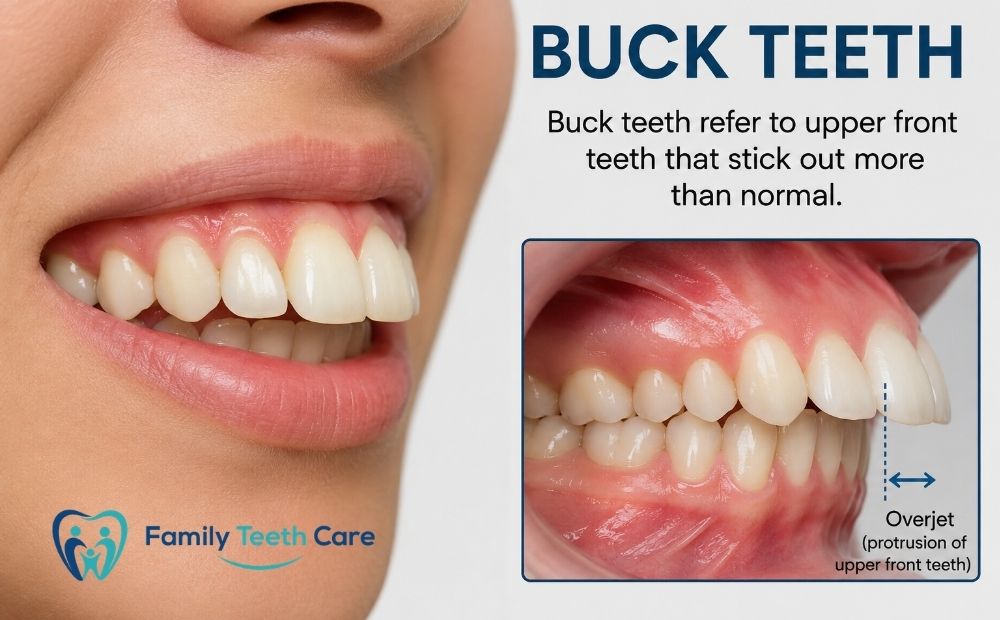
Buck teeth is a common phrase people use when the upper front teeth stick out more than usual. In dental terms, this is often called an overjet, which means the upper front teeth extend forward beyond the lower front teeth. It is different from an overbite, where the upper teeth overlap the lower teeth vertically. In orthodontics, dentists and orthodontists look at tooth position, jaw growth, bite function, and facial balance before deciding whether treatment is needed.
What Are Buck Teeth?
Buck teeth usually describe upper front teeth that protrude outward. Some people have a mild overjet that is barely noticeable, while others have a more obvious forward position of the front teeth.
This condition can affect appearance, speech, chewing, lip closure, and confidence. For some people, buck teeth are mostly a cosmetic concern. For others, they may increase the risk of tooth injury, uneven bite pressure, gum irritation, or jaw discomfort.
Cleveland Clinic explains that overjet refers to horizontal misalignment where the upper teeth protrude beyond the lower front teeth, while overbite refers to vertical overlap.
Buck Teeth vs. Overbite: What Is the Difference?
Many people use the words “buck teeth” and “overbite” as if they mean the same thing, but they are not exactly the same.
Buck teeth usually refer to an overjet, where the upper front teeth stick forward. Overbite refers to a deep vertical overlap, where the upper front teeth cover too much of the lower front teeth.
A person can have one or both conditions at the same time. That is why a dental exam is important. A dentist or orthodontist can measure the bite properly and explain what type of alignment issue is present.
What Causes Buck Teeth?
Buck teeth can happen for several reasons. Some causes are genetic, while others are related to habits during childhood.
One common reason is jaw size or jaw position. If the upper jaw grows too far forward or the lower jaw is set back, the upper teeth may look more prominent. Tooth crowding can also push front teeth forward.
Childhood habits can also play a role. Thumb sucking, pacifier use beyond the recommended age, tongue thrusting, and mouth breathing may affect how the teeth and jaws develop. MouthHealthy from the American Dental Association notes that bad bites may be inherited or may result from injury, early or late tooth loss, or thumb sucking.
Are Buck Teeth Always a Problem?
Not always. Mild buck teeth may not cause serious issues. Some people have slightly forward front teeth and never need treatment. However, more noticeable cases can affect both appearance and oral function.
Buck teeth may make it harder to close the lips comfortably. They may also make the front teeth more exposed. This can increase the risk of chips or injury during falls, sports, or accidents.
If the bite does not meet properly, some teeth may carry too much pressure. Over time, this can contribute to tooth wear, gum problems, or jaw discomfort.
How Buck Teeth Can Affect Confidence
Teeth are a big part of facial appearance. When front teeth stick out, some people feel embarrassed while smiling, laughing, or taking photos. Children may also feel self-conscious if classmates comment on their teeth.
This emotional effect matters. Dental treatment is not only about looks; it can also help people feel more comfortable speaking, smiling, and socializing.
A good dental plan should focus on both oral health and confidence.
Can Buck Teeth Affect Speech?
Yes, in some cases. The front teeth help guide certain sounds, especially sounds like “s,” “f,” and “v.” If the front teeth are too far forward, speech may sound slightly different.
Not everyone with buck teeth has speech problems, but if speech is affected, orthodontic treatment may help. In some cases, a dentist may also recommend working with a speech therapist, especially for tongue thrust habits.
Can Buck Teeth Affect Chewing?
Buck teeth can affect chewing if the upper and lower teeth do not meet properly. A balanced bite helps distribute chewing pressure evenly. If the bite is uneven, some teeth may work harder than others.
This can lead to discomfort, faster tooth wear, or difficulty biting into certain foods. A dentist can check whether the bite is functioning properly or whether orthodontic treatment would help.
Why Early Dental Visits Matter for Children
Children should have regular dental checkups because early signs of bite problems can often be spotted before they become more serious. If a child has thumb sucking, tongue thrusting, mouth breathing, or a developing jaw issue, early advice may prevent more complex treatment later.
Not every child with buck teeth needs early treatment. Sometimes the dentist simply monitors growth. In other cases, an orthodontist may recommend appliances, braces, or habit correction at the right age.
Early guidance can make treatment easier and more effective.
Braces for Buck Teeth
Braces are one of the most common treatments for buck teeth. They use brackets and wires to gradually move teeth into better positions. Braces may be recommended for moderate or more complex cases, especially when the bite needs detailed correction.
Braces can help bring protruding front teeth backward, align crowded teeth, and improve the way upper and lower teeth meet. Treatment time depends on the severity of the case and the patient’s age.
MouthHealthy explains that braces and orthodontic treatment are used to correct malocclusion, including crowded or crooked teeth and jaw alignment problems.
Clear Aligners for Buck Teeth
Clear aligners may also help correct mild to moderate buck teeth. These are removable trays that gradually move teeth. They are popular because they are less visible than braces.
However, clear aligners are not suitable for every case. If the problem is severe or related to jaw position, braces or other orthodontic options may be needed. Aligners also require discipline because they must be worn for the recommended number of hours each day.
A dentist or orthodontist can decide whether aligners are appropriate after examining the teeth and bite.
Orthodontic Appliances for Growing Children
For children whose jaws are still growing, orthodontists may use special appliances to guide jaw development. These appliances may help correct jaw relationships, widen the upper jaw, or reduce harmful habits.
Treatment depends on the child’s age, growth pattern, and bite problem. Some children may need early appliances followed by braces later. Others may only need monitoring until more permanent teeth come in.
The goal is to guide growth in a healthier direction and reduce future complications.
Tooth Extraction and Buck Teeth
In some cases, orthodontists may recommend removing teeth to create space. This is usually considered when the mouth is crowded and the front teeth need room to move back.
Tooth extraction is not needed for every case. It depends on jaw size, tooth crowding, facial profile, and treatment goals. A good orthodontist will explain why extraction is or is not recommended.
The decision should always be based on long-term function, appearance, and oral health.
Surgery for Severe Buck Teeth
Severe buck teeth caused by jaw imbalance may sometimes require jaw surgery, especially in adults whose jaw growth is complete. Surgery is usually reserved for serious skeletal problems that cannot be corrected with braces or aligners alone.
Most people with buck teeth do not need surgery. But for severe cases, orthodontic treatment combined with jaw surgery may improve bite function, facial balance, and long-term comfort.
A specialist can explain whether surgery is necessary after a full examination.
Can Buck Teeth Be Fixed at Home?
No, buck teeth should not be treated with home methods. Trying to push teeth back with fingers, rubber bands, or online DIY devices can damage teeth, gums, and bone.
Teeth move safely only when controlled pressure is applied in the right direction over time. Orthodontic treatment is planned carefully to protect roots, gums, and bite function.
If you want to improve buck teeth, the safest first step is a professional dental consultation.
What Happens During a Dental Consultation?
During a consultation, the dentist or orthodontist checks the teeth, gums, bite, jaw position, and facial profile. They may take photos, X-rays, scans, or impressions.
They will measure how far the upper teeth stick out and check whether the issue is caused by tooth position, jaw position, habits, or crowding. After that, they can explain treatment options.
A consultation also helps identify other dental problems such as cavities, gum disease, enamel wear, or missing teeth.
How Long Does Treatment Take?
Treatment time depends on the severity of the case. Mild buck teeth may improve in several months with aligners or braces. More complex cases may take one to three years.
Children may need treatment in phases. Adults may need more detailed planning, especially if jaw position or missing teeth are involved.
Your dentist or orthodontist can give a realistic timeline after reviewing your bite.
Are Buck Teeth Treatment Results Permanent?
Results can last for many years, but retainers are usually needed after orthodontic treatment. Teeth naturally try to shift over time. Retainers help keep them in their new positions.
If retainers are not worn as instructed, teeth may slowly move back. This is why aftercare is just as important as active treatment.
How to Care for Teeth During Treatment
If you have braces, brushing and flossing need extra attention. Food can get trapped around brackets and wires. Use a soft toothbrush, fluoride toothpaste, floss threaders, or interdental brushes if recommended.
If you use clear aligners, clean your teeth before putting trays back in. Wearing aligners over food particles can increase the risk of cavities and bad breath.
Regular dental checkups and cleanings are important during orthodontic treatment.
Can Adults Fix Buck Teeth?
Yes, adults can often fix buck teeth. Braces and clear aligners are common options for adults. The main difference is that adult jaws are no longer growing, so treatment may take more planning if the issue is skeletal.
Adults may also have old fillings, crowns, gum recession, missing teeth, or bone changes that need to be considered. A dentist or orthodontist can create a safe treatment plan based on the full mouth condition.
What If You Do Not Treat Buck Teeth?
Mild buck teeth may not need treatment if they do not affect function, health, or confidence. However, untreated moderate or severe buck teeth may increase the risk of front tooth injury, bite problems, speech concerns, tooth wear, and gum irritation.
The best choice depends on the individual case. A professional evaluation can help you understand whether treatment is optional or recommended.
How to Prevent Buck Teeth in Children
Not all cases can be prevented because genetics play a major role. However, some habits can be managed early.
Parents should talk to a dentist if a child continues thumb sucking or pacifier use for too long. Mouth breathing, tongue thrusting, and early tooth loss should also be checked.
Good oral hygiene, regular dental visits, and early orthodontic screening can help protect a child’s developing smile.
Choosing the Right Treatment
The best treatment for buck teeth depends on the cause. If the teeth are simply angled forward, braces or aligners may work well. If the jaw relationship is the main issue, appliances or surgery may be discussed. If the concern is mild and mostly cosmetic, limited orthodontic treatment may be enough.
A dentist or orthodontist should explain the benefits, risks, cost, and timeline of each option before treatment begins.
FAQs About Buck Teeth
What are buck teeth?
Buck teeth usually refer to upper front teeth that stick out more than usual. Dentists often call this an overjet.
Are buck teeth the same as an overbite?
No. Buck teeth usually describe horizontal protrusion of the upper front teeth. An overbite describes vertical overlap of the upper teeth over the lower teeth.
What causes buck teeth?
Buck teeth may be caused by genetics, jaw growth, tooth crowding, thumb sucking, tongue thrusting, mouth breathing, or early tooth loss.
Can braces fix buck teeth?
Yes, braces can often fix buck teeth by moving teeth into better alignment and improving bite position.
Can clear aligners fix buck teeth?
Clear aligners may help mild to moderate cases. Severe cases or jaw-related problems may need braces or other orthodontic treatment.
Can buck teeth go away naturally?
Usually, buck teeth do not fully correct themselves without treatment, especially if they are caused by jaw position, habits, or crowding.
Are buck teeth bad for oral health?
Mild cases may not be harmful. More severe cases can increase the risk of tooth injury, uneven wear, bite problems, or gum irritation.
When should a child see an orthodontist for buck teeth?
A child should see a dentist regularly, and the dentist may recommend an orthodontic evaluation if bite problems are developing. Early advice can help guide treatment at the right time.
Final Thoughts
Buck teeth are common, and they can range from a minor cosmetic concern to a more serious bite issue. For some people, they affect confidence. For others, they can affect speech, chewing, tooth wear, or the risk of dental injury.
The good news is that modern dentistry offers many safe treatment options. Braces, clear aligners, growth appliances, and other orthodontic treatments can help improve both appearance and function.
If you or your child has buck teeth, the best step is to book a dental or orthodontic consultation. A professional can explain the cause, treatment options, and the healthiest path toward a more balanced smile.
Visit familyteethcare.com for more helpful dental care guides and oral health tips.